Why an AI agent should not review its own work
A model checking its own output is a weaker check than it looks. What the research on LLM judges shows, where it is uncertain, and who should do the checking.
On this page
In short
- A model's review of its own output should not count as an independent check. In tests of GPT-3.5, GPT-4 and Llama 2 in 2023 and 2024, models recognised their own text, and GPT-4 and GPT-3.5 tended to score their own news summaries above other sources'. The authors call this indirect evidence of self-preference.
- Asked to correct their own answers with no outside signal, models often did not improve. GPT-4, tested in August 2023, fell from 95.5% to 91.5% accuracy on GSM8K maths problems after one round of self-correction (Huang et al., ICLR 2024).
- Newer studies show self-preference varies by model: in a 2026 test of 20 models, 8 favoured their own output and 9 disfavoured it. A checker cannot be assumed neutral, so use a different model (my inference, not a tested result) or a person, and have a person read a sample.
If an AI agent writes something, can the same model check it? It can look, but that look is not an independent check. Tests of GPT-3.5, GPT-4 and Llama 2 in 2023 and 2024 found that models recognise their own text, that some score it above other sources', and that without an outside signal they often fail to fix their own mistakes. I would give the check to a different model or a person, and have a person read a sample of what passed. The different-model part is my inference, not a tested result.
The claim: self-review is not an independent check
A second pass by the same model still has uses: it can tidy wording and catch slips. It just should not decide whether the work ships. Wataoka and colleagues (2024) found that GPT-4 rated text familiar to it higher, whether or not it wrote it, and a model's own writing is likely to be among the most familiar.
Why is the same model a weak checker?
- Models recognise their own text, and some favour it. Panickssery, Bowman and Feng (NeurIPS 2024) tested GPT-3.5 Turbo, GPT-4 and Llama 2 on news summaries. Without training for it, GPT-4 told its own summaries from those of two other models and humans 73.5% of the time. GPT-4 and GPT-3.5 tended to score their own summaries above other sources', which the authors call indirect evidence of self-preference. In a 2025 study of 9 judges that adjusted for quality judged by humans, Spiliopoulou and colleagues found that some, including GPT-4o and Claude 3.5 Sonnet, systematically scored their own outputs higher, and their own model family's too.
- Without outside feedback, self-correction often makes things worse. Huang and colleagues (ICLR 2024) asked GPT-4, tested in August 2023, to review and correct its answers to GSM8K maths problems. Accuracy fell from 95.5% to 91.5% after one round. Earlier reported gains depended on using the correct answer to decide when to stop. Kamoi and colleagues' 2024 survey agrees: self-correction works where reliable outside feedback exists.
- The harmful bias shows up exactly where a review matters. Chen and colleagues (2025), across seven model families, found that much of a strong model's preference for its own work matches real quality. But judges still favoured their own wrong answers, and stronger models did so more. A review exists for the case where the writer was wrong.
The strongest objection: model judges agree with people
In Self-Refine (Madaan and colleagues, 2023), one model drafts, critiques and revises its own work. Across seven tasks with GPT-3.5, ChatGPT and GPT-4, its outputs were preferred by people and automatic metrics, and task performance improved by about 20% absolute on average. Zheng and colleagues (2023) found that GPT-4 as a judge agrees with human experts about as often as experts agree with each other.
Newer work also questions the size of the effect. Roytburg and colleagues (2026) found that only 51% of examples from four earlier landmark results stayed significant against a control built from other models' equally weak answers, though the surviving examples held 89.6% of the measured self-preference. In Yang and colleagues' 2026 study of 20 models, 8 favoured their own output, 9 disfavoured it and 3 were near zero.
I take this seriously. A model cannot be assumed to favour itself. Nor can it be assumed neutral, which an independent check needs. Self-Refine's gains and Huang's losses disagree; the difference seems to lie in the task and the feedback available.
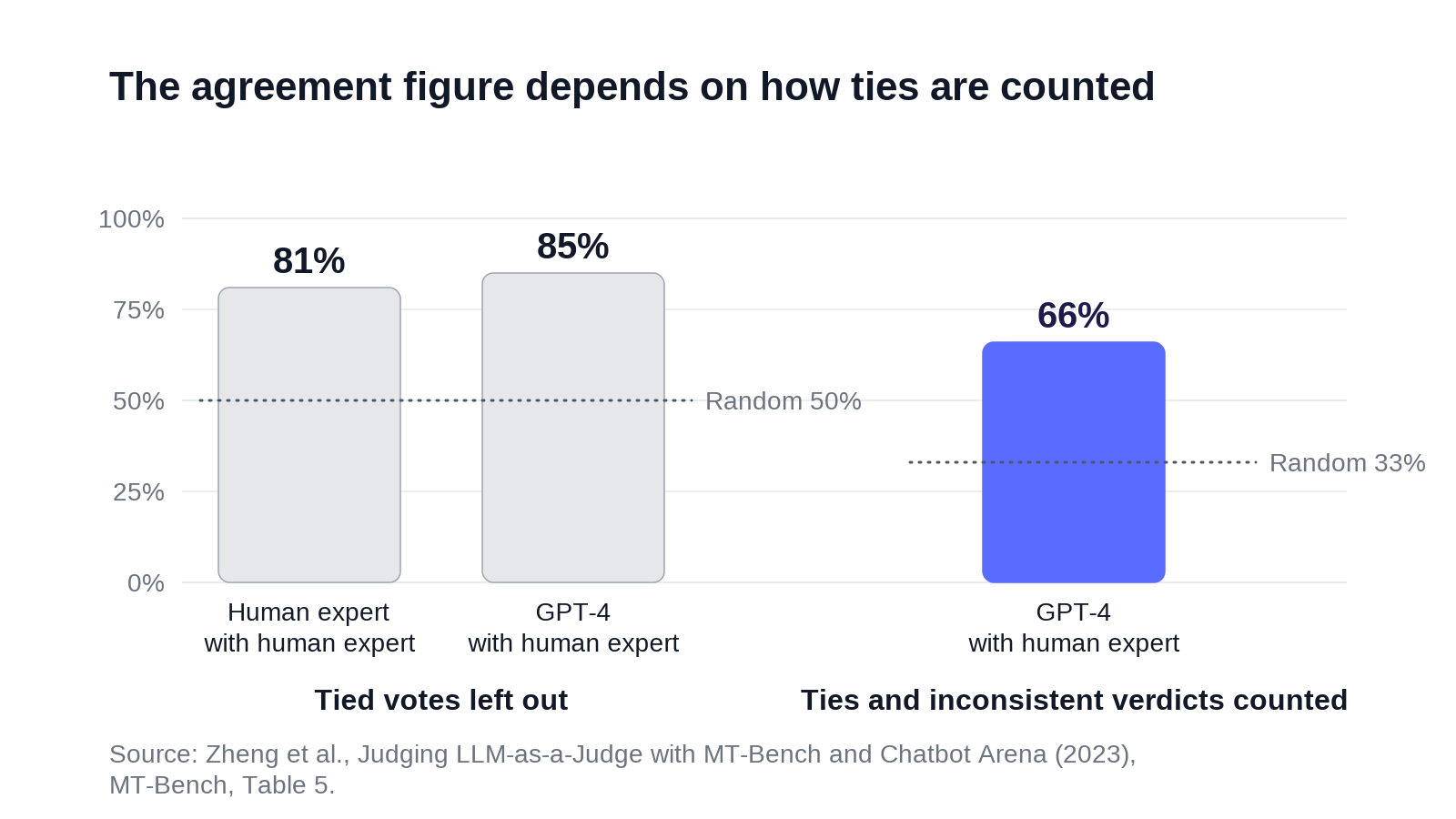
The agreement figure has conditions. On MT-Bench, a set of multi-turn questions, GPT-4 and experts picked the same winner 85% of the time when tied votes were left out; experts agreed with each other 81%. Counting ties and inconsistent verdicts, GPT-4 and humans agreed 66%. And GPT-4 was mostly judging other models' answers, not its own.
What this means for your agent set-up
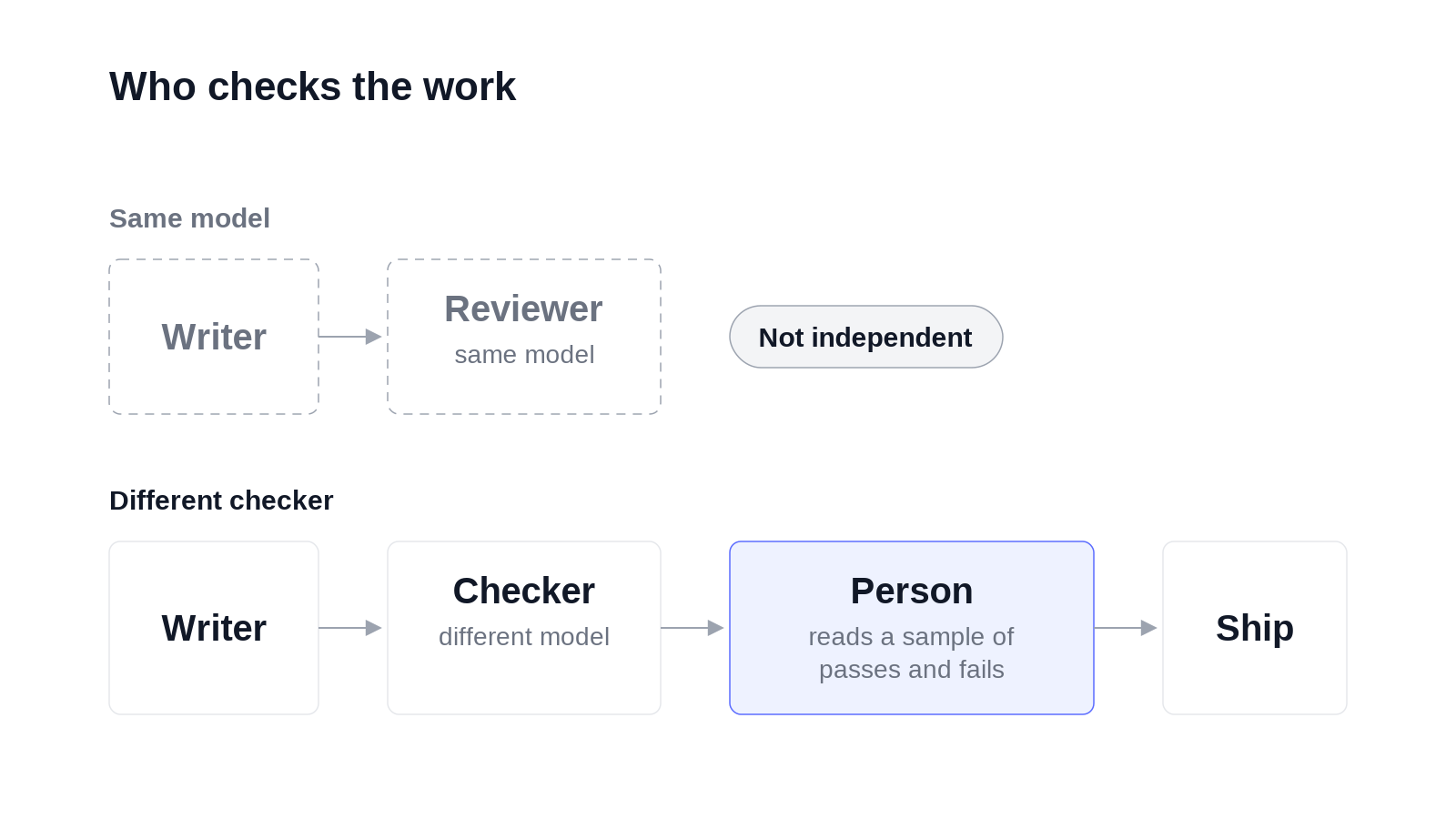
Anthropic's engineers recommend an "evaluator-optimizer" loop (2024), where one LLM writes and another evaluates, when the criteria are clear. They do not say whether the second should be a different model. I would make it one, in three steps.
- Make the checker a different model, ideally from a different maker. This is my inference, not a tested result: I found no study comparing same-model and different-model checking with people grading both. The family-bias and familiarity findings suggest a different model is safer, not safe.
- Have a person read a sample of passes and fails. Anthropic's evals guide (January 2026) says a model grader "requires calibration with human graders for accuracy", and recommends regularly sampling transcripts rather than reading all of them.
- Record which model writes and which checks, and re-test when either changes. The evidence is for named models in named years. Yours will be newer.
This is the Lean UX principle of outcomes, not output applied to agents: a confident output is not proof the work is right. The same principle, applied to AI features, is the subject of Does Lean UX still work for AI products?
What to do next
This week, find one step in your agent workflow where the writer and the reviewer are the same model. Switch the reviewer to a different model or a person. Read ten of its passes and ten of its fails yourself, and note where you disagree. That note is your first calibration.
Common questions
Can an LLM review its own output at all?
Yes, and a second pass can still tidy wording or catch slips. The problem is treating it as an independent check. Research on 2023 to 2025 models found that self-correction works well where reliable outside feedback exists, such as tests or a correct answer, and often fails without it.
Is GPT-4 as a judge as reliable as a human?
Partly. On MT-Bench, a set of multi-turn questions, GPT-4 and human experts picked the same winner 85% of the time when tied votes were left out, against 81% between experts. When ties and inconsistent verdicts were counted, GPT-4 and humans agreed 66% of the time (Zheng et al., 2023).
How much of an agent's output should a person read?
Not all of it. Anthropic's engineers recommend calibrating model graders against human graders and reading a regular sample of transcripts, because full manual review does not scale. Read some of what the checker passed and some of what it failed.
Sources
- LLM Evaluators Recognize and Favor Their Own GenerationsPanickssery, Bowman and Feng, arXiv (NeurIPS 2024), April 2024
- Play Favorites: A Statistical Method to Measure Self-Bias in LLM-as-a-JudgeSpiliopoulou et al., arXiv, August 2025
- Large Language Models Cannot Self-Correct Reasoning YetHuang et al., arXiv (ICLR 2024), October 2023, revised March 2024
- When Can LLMs Actually Correct Their Own Mistakes? A Critical Survey of Self-Correction of LLMsKamoi, Zhang, Zhang, Han and Zhang, arXiv (TACL 2024), June 2024, revised December 2024
- Do LLM Evaluators Prefer Themselves for a Reason?Chen, Wei, Zhu, Feng and Meng, arXiv, April 2025, revised December 2025
- Quantifying and Mitigating Self-Preference Bias of LLM JudgesYang et al., arXiv, April 2026, revised June 2026
- Self-Refine: Iterative Refinement with Self-FeedbackMadaan et al., arXiv, March 2023, revised May 2023
- Judging LLM-as-a-Judge with MT-Bench and Chatbot ArenaZheng et al., arXiv (NeurIPS 2023 Datasets and Benchmarks), June 2023, revised December 2023
- Are LLM Evaluators Really Narcissists? Sanity Checking Self-Preference EvaluationsRoytburg et al., arXiv (ICML 2026), January 2026, revised June 2026
- Self-Preference Bias in LLM-as-a-JudgeWataoka, Takahashi and Ri, arXiv (NeurIPS 2024 Safe Generative AI Workshop), October 2024, revised June 2025
- Demystifying evals for AI agentsAnthropic Engineering, 9 January 2026
- Building effective agentsAnthropic Engineering, 19 December 2024
Get in touch
Have a question about this article, or see it differently? I read every message.
Email me