Does Lean UX still work for AI products?
Lean UX still works for AI products. Four steps need more care, from picking the outcome to life after launch, and three new tools help. Here is what holds.
On this page
In short
- Lean UX still works for AI products: its central principle, that progress is measured by outcomes and not output, still holds, and AI makes skipping discovery riskier, not safer.
- Four Lean UX steps need more care when an AI's output varies from one run to the next: choosing the outcome, testing the first version, deciding what done means, and watching the feature after launch.
- For the last three of those steps, Jeff Gothelf, who created Lean UX, proposes one new tool each: a failure line on the hypothesis, acceptance criteria written as a share of inputs, and a tripwire metric with a rehearsed rollback.
Does Lean UX, the method Jeff Gothelf set out in 2013, still work when the product is an AI feature whose answer changes from one run to the next? Mostly, yes. Its central idea, that progress is measured by outcomes and not by output, holds as well as ever. What changes is how much care four of the steps need: choosing the outcome, testing the first version, deciding when a feature is done, and watching it after launch. For the last three, Gothelf proposes one new tool each.
A note on the evidence before we start. Most of the AI-specific advice in this article comes from one author, Jeff Gothelf, who created Lean UX and also sells Lean UX books and courses. These are a practitioner's arguments, not studies. None of the sources I read tests whether teams that follow them get better results.
What Lean UX asks of a team
Lean UX is a way to design products in a small, mixed team that builds something quickly, tests it with real users and learns from the result. It stands on three foundations: design thinking, agile software development and the Lean Startup method. Gothelf introduced it in the 2013 book Lean UX, written with Josh Seiden. In a 2025 post he notes that the book is now in its third edition.
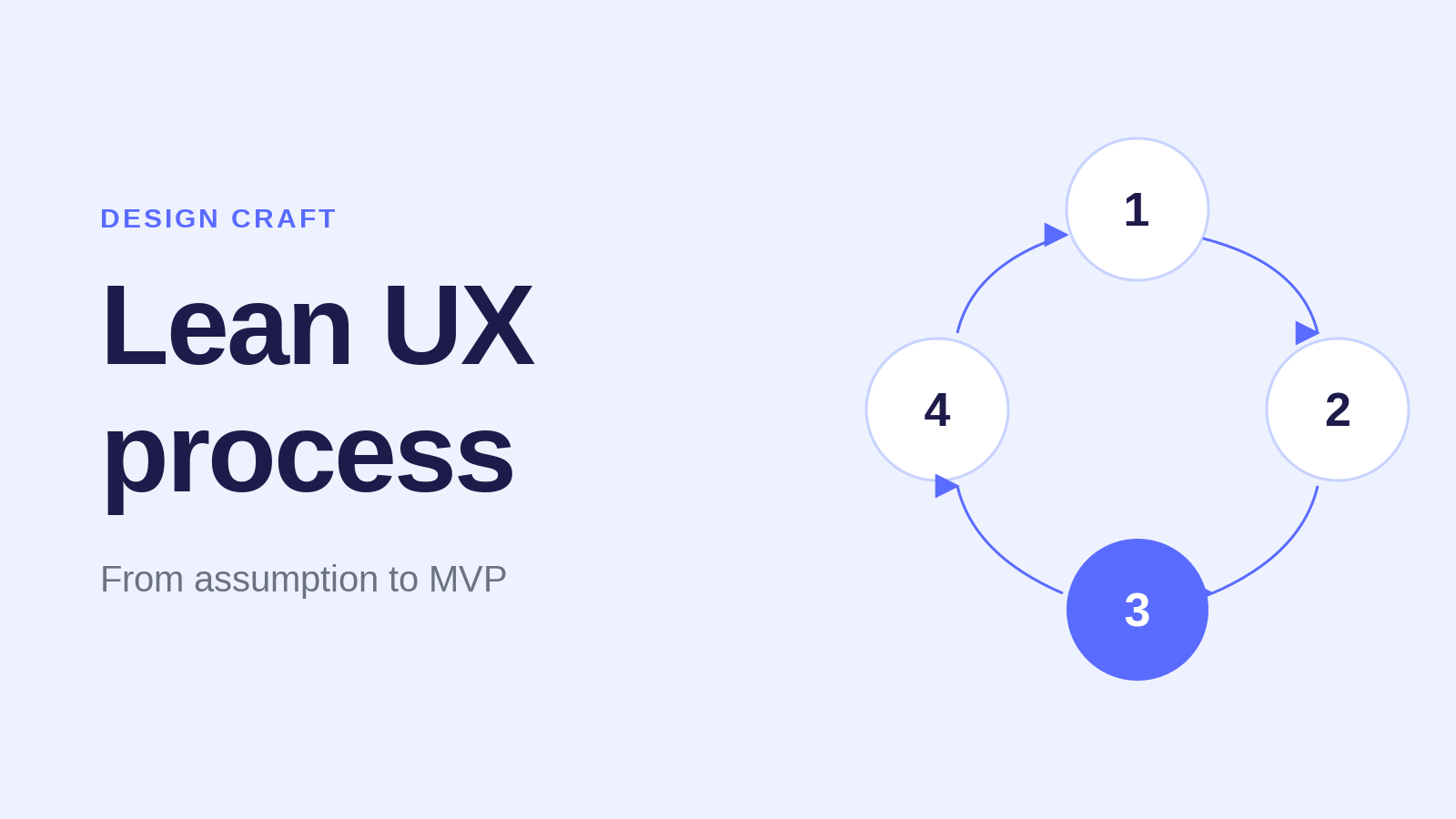
I wrote about Lean UX on Medium in 2021, and both articles are revised on this site. The first covers the three foundations and the 15 principles. The second covers the four-step process and how to build an MVP: declare assumptions, create a minimum viable product (MVP), run an experiment, then learn from feedback and go round again.
All of this was written for software that does the same thing every time. This article asks what happens to it when that is no longer true.
Why AI features strain the method
Gothelf describes classic software as a vending machine: the same input gives the same output. "Done" meant that the tests passed, the spec was met and QA agreed. With an AI feature, he writes, the same prompt can give different outputs across users, sessions and model updates. Ten people making the same request may get ten different results. So what a team ships is not one behaviour but a range of behaviours, and passing the tests no longer means the feature is done.
| Classic feature | AI feature | |
|---|---|---|
| Same input | Same output every time | Output can differ by user, session and model update |
| "Done" means | Tests pass, spec met, QA agrees | Most inputs meet a quality bar, the rest fail gracefully |
| First test | Does the prototype work for the user? | Does the model's output hold up across many real inputs? |
| After launch | Behaves as it did in testing | Behaviour can keep surprising the team |
The output is now part of the product, and people can treat it as a promise. In 2024, as reported by the law firm Manatt, a tribunal in British Columbia found that Air Canada had to honour a refund policy its chatbot had described, although the airline's real policy did not allow it. A screen design can be right and the feature still wrong, because of what the model said.
Gothelf's 2025 argument is that this makes discovery more necessary, not less. AI prototyping tools such as Lovable, Bolt and V0 can produce a clickable prototype in minutes, which can make discovery feel optional. His conclusion is the opposite: AI shortens the time it takes to learn, but the team still has to learn. If evidence does not reach product decisions, AI only helps build more things nobody needs.
Which Lean UX principles still hold for AI?
Here is how I would sort the 15 principles for AI products. This is my reading of Gothelf's recent posts, not a finding, and other people could sort them differently.
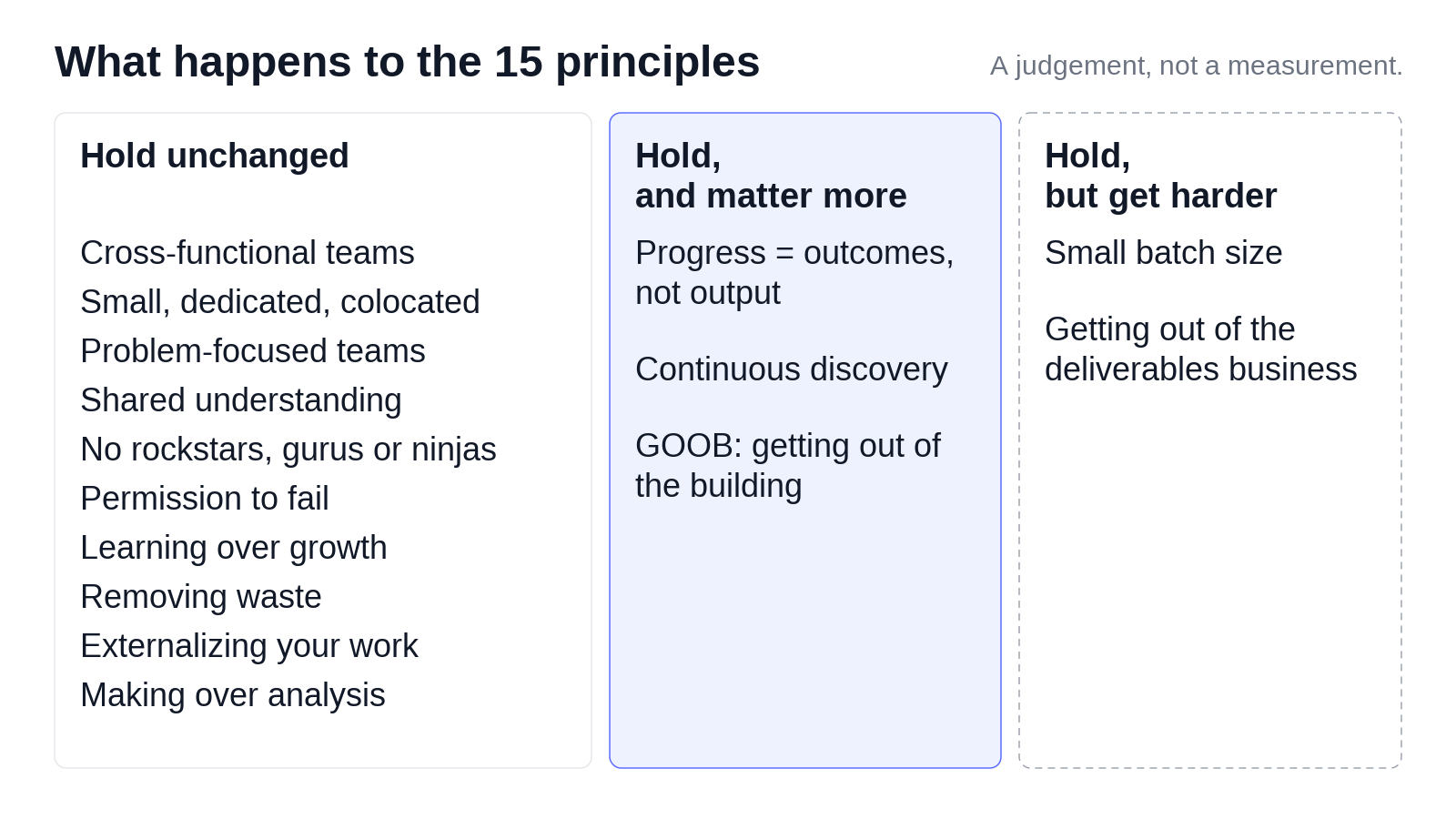
- Ten hold unchanged. Cross-functional teams; small, dedicated, colocated; problem-focused teams; shared understanding; no rockstars, gurus or ninjas; permission to fail; learning over growth; removing waste; externalizing your work; making over analysis. These are about how the team is set up and how it thinks, not about how the product behaves. Nothing in the sources argues against them. Making is cheaper than ever, which helps, as long as each thing made has a question to answer.
- Three hold, and matter more. Progress = outcomes, not output; continuous discovery; getting out of the building. Gothelf puts it this way: "The old Lean UX argument was that outputs aren't outcomes." For AI features, he adds, "shipping the feature isn't the same as the customer succeeding with it." I read that principle as still holding, and as mattering more. In his 2025 post he also argues that a feature that works as designed shows how fast the team moved, not whether it helped anyone.
- Two hold, but get harder. Small batch size is harder because a small batch of AI behaviour is still a range of answers, not one screen. Getting out of the deliverables business is the hardest to sort. It still holds, but the new tools below are documents of a sort: written criteria, a playbook, a threshold. I would keep them, and keep them short.
How to run Lean UX on an AI feature
The loop stays the same. Four steps need more care. For the first, Gothelf offers a question to ask; for the other three, a new tool.
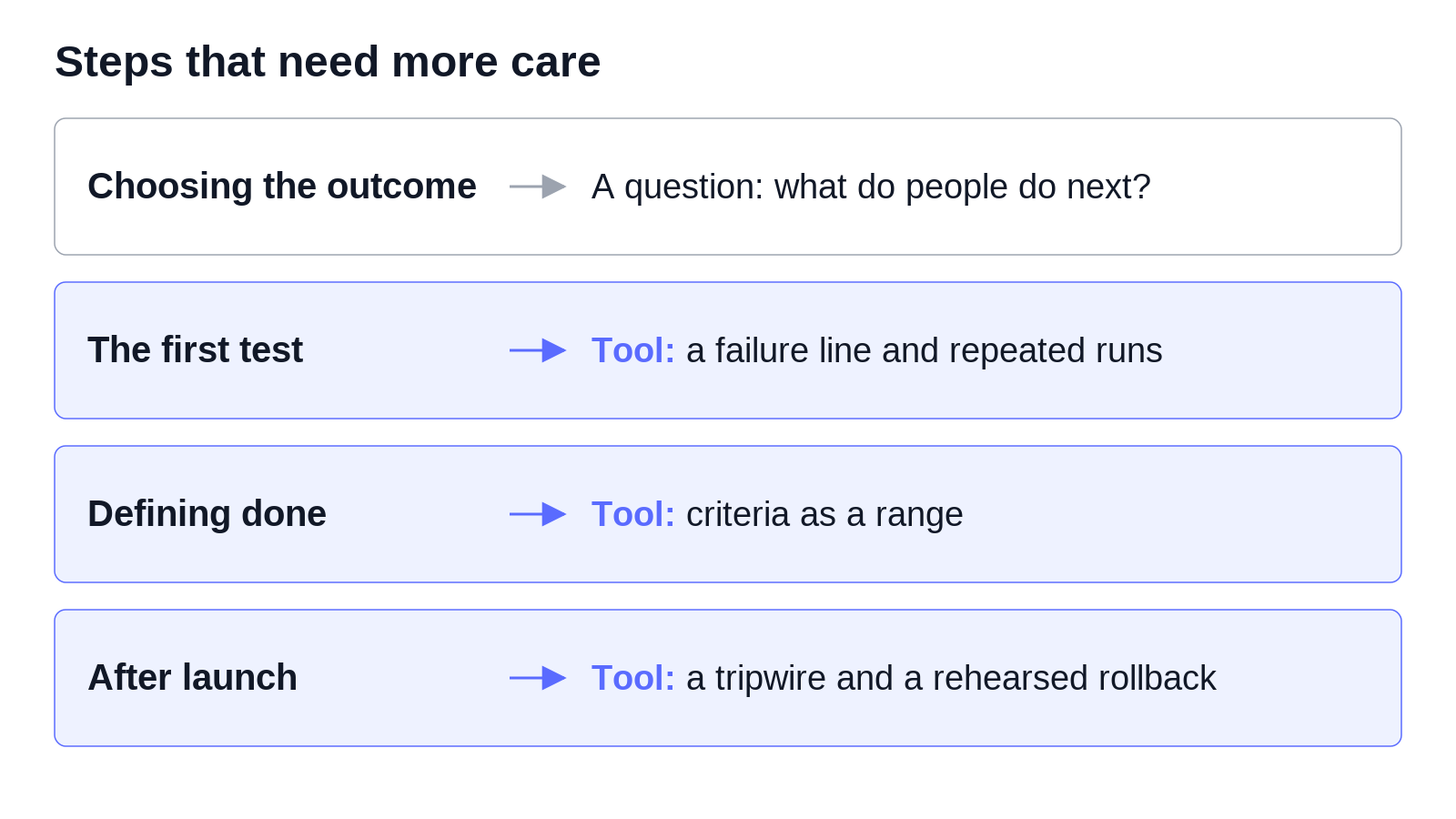
- Name the behaviour you expect to change. Gothelf defines outcomes as measurable changes in human behaviour that drive business results. For an AI feature, he suggests asking what people will do differently if the answer is useful, and if it is useless. Do they leave the tool, rephrase the question, ask one follow-up, or ask several? No reaction is good or bad in itself. A research tool may want several follow-ups; another product may want the right answer first time. Behaviour alone does not show value, so pair it with what users tell you directly.
- Give the hypothesis a failure line, and test it before you build. Write the Lean UX hypothesis as usual, then add what observable behaviour, at what level, by what date, would show the team is wrong. Gothelf's example is an assistant that drafts replies to billing questions: the team is wrong if fewer than six in ten drafts need only light edits during a two-week pilot. Before building, the team runs 200 real tickets from last quarter through the model, five times each, and sets the pass mark at eight in ten drafts rated sendable. Repeating each input matters because the output varies. The business outcome stays outside this test, because only customers can confirm it.
- Write "done" as a range. Gothelf proposes acceptance criteria written as a share of inputs rather than a yes or no. His illustration: about 80% of inputs in a category meet the quality bar, and the other 20% fail gracefully. The 80% is his example, not a recommended number. Keep two sets of criteria: fixed ones for the predictable parts, such as sign-in, billing and navigation, and ranges for the AI's answers.
- Ship with a tripwire and a rehearsed rollback. Every AI feature, Gothelf writes, should launch with a tripwire metric, a threshold set before launch and a rollback the team has actually practised. His examples of tripwires include the error rate, escalations to human review and off-tone complaints per thousand sessions. He also suggests a short playbook, written before launch, naming who owns model-quality, interface, content and public-relations problems, which he contrasts with the old habit of triaging once complaints surface.
Common mistakes with AI features
- Treating a fast prototype as discovery. A prototype made in minutes can look finished and teach almost nothing. Gothelf's advice is to treat each prototype as a hypothesis: agree beforehand what would signal that it is done, and design the cheapest test that could show the direction is wrong.
- Reading usage as value. A rise in sessions or follow-up questions can mean the feature helps, or that people are struggling with it. Without direct feedback from users, Gothelf argues, the team cannot tell which. In other words, usage is not value.
- Testing with simulated users instead of real ones. It is tempting to let a model play the user. Pratik Joglekar, a product designer writing in Smashing Magazine, warns that simulations do not replace experiments. His example: a model trained mostly on mobile data might predict low engagement for a voice interface for older users, because of its training data and not because the idea is weak. We still have to learn what people want, not just what they say, and a model cannot tell us either.
What to do next
Pick one AI feature your team is building or planning. This week, write two sentences and agree them with the team: the behaviour you expect to change, and what result, by what date, would show you are wrong.
The next article in this series shows how to test those two sentences against real inputs before you build.
If you want to see small AI products built end to end with AI, the AI Lab shows three.
Common questions
What is a tripwire metric for an AI feature?
A tripwire metric is a measure, agreed before launch, that tells the team the AI feature is going wrong in live use. Jeff Gothelf's examples include the error rate, escalations to human review and off-tone complaints per thousand sessions. Each comes with a threshold set in advance and a rollback the team has already rehearsed.
Can AI-generated personas or simulated users replace user research?
No. Pratik Joglekar, writing in Smashing Magazine in 2026, argues that simulations do not replace experiments, because a model's prediction reflects its training data and not the worth of the idea. Simulated users can help a team prepare questions, but only real users show what people do.
Can an AI MVP still be a prototype without code?
A clickable prototype can still test whether people want the feature at all. In my view it cannot show how the model behaves across many real inputs, because a screen mock shows one answer. For that part, run real inputs from the intended users through the model, several times each, before building the full product.
Sources
- Lean UX: Applying Lean Principles to Improve User ExperienceJeff Gothelf and Josh Seiden, O'Reilly Media, 2013
- Finding outcomes for non-deterministic systemsJeff Gothelf, jeffgothelf.com, 27 October 2025
- AI Isn't Killing Product Discovery. It's Making It EssentialJeff Gothelf, jeffgothelf.com, 3 November 2025
- Three Habits That Beat AI Tool FluencyJeff Gothelf, jeffgothelf.com, 4 May 2026
- What "done" means when you're shipping AI featuresJeff Gothelf, jeffgothelf.com, 1 June 2026
- How to turn a Lean UX hypothesis into an AI eval before you build anythingJeff Gothelf, jeffgothelf.com, 12 October 2026
- Designing With Uncertainty: How AI Supercharges Probabilistic ThinkingPratik Joglekar, Smashing Magazine, 16 June 2026
- AI Gone Wild: Airline Has to Honor a Refund Policy Its Chatbot FabricatedJesse M. Brody, Manatt, Phelps & Phillips, 28 February 2024
Get in touch
Have a question about this article, or see it differently? I read every message.
Email me