
What is Lean UX? Its foundations and 15 principles
Lean UX is a collaborative way to design products fast and learn from real users. Here are its three foundations and Gothelf's 15 principles, in plain words.
In short
- Lean UX is a collaborative, cross-functional way to design products quickly and learn from real users. Jeff Gothelf introduced it in 2013.
- Lean UX stands on three foundations: design thinking, agile software development and the Lean Startup method.
- The fifteen Lean UX principles describe how a team is set up, how it thinks and how it works. Outcomes matter more than documents.
Many people have asked me about UX, Lean UX and software development. How is software designed? Which tools and methods are used, and when? Lean UX is my short answer to most of those questions. It is a way of designing products in which a small, mixed team builds something quickly, tests it with real users and learns from the result, instead of writing long documents first.
I first published this article on Medium in October 2021. This is a revised edition. The ideas are the same and the wording is clearer.
What is Lean UX?
Lean UX is a set of practices for developing products in a collaborative, cross-functional way. It grew out of the Lean Startup method and agile software development. Jeff Gothelf introduced it in his 2013 book Lean UX, building on the Lean Startup principles that Eric Ries published in 2011.
The aim of Lean UX is to build a product fast, with limited resources, without losing sight of what the customer needs. It takes the older way of doing human-centred design and makes it quicker and more iterative.
According to Gothelf, Lean UX gives less attention to documentation. It puts the effort into building a shared understanding of the actual product, across the whole team.
What is Lean UX built on?
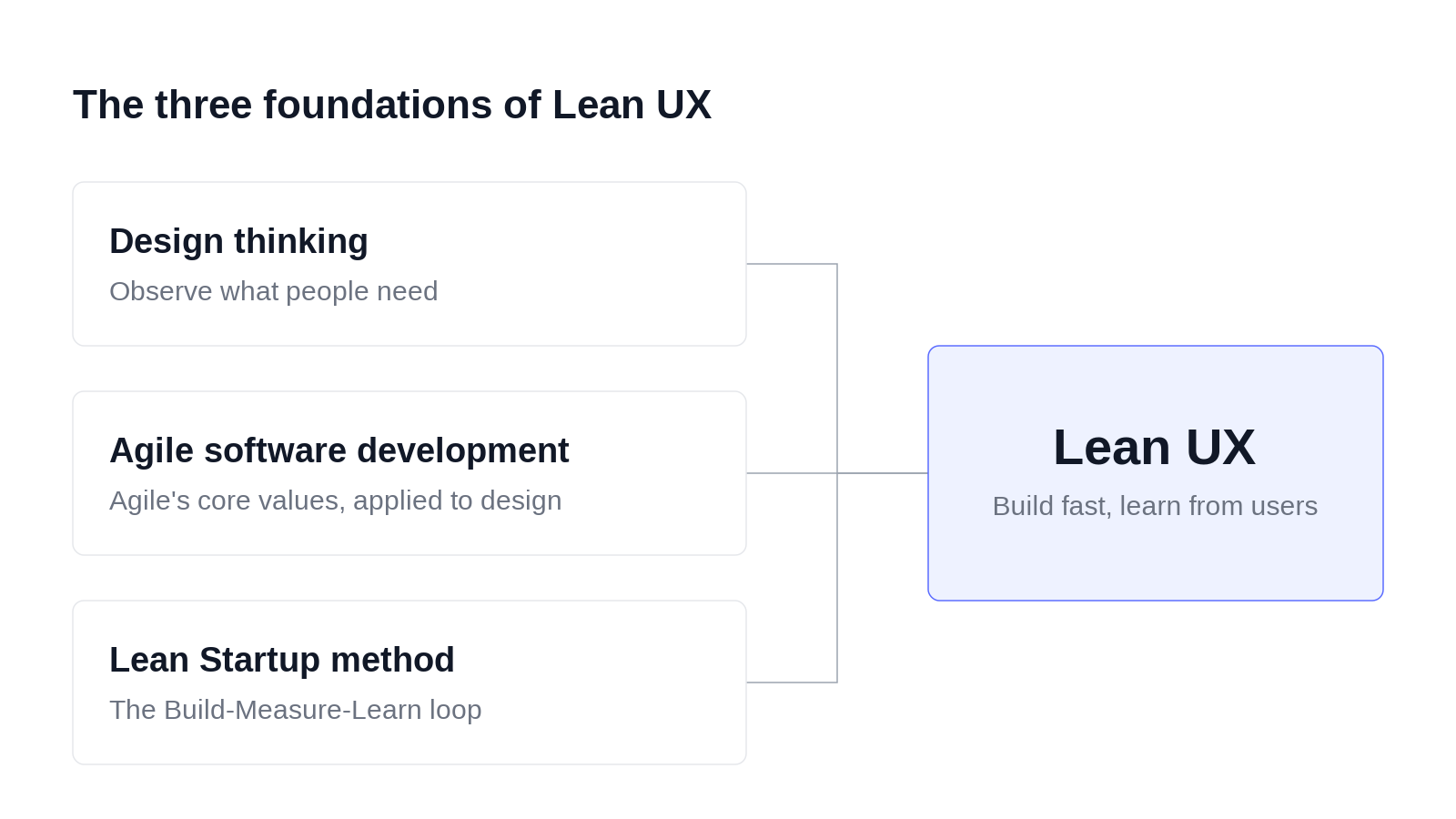
Lean UX has three foundations: design thinking, agile software development and the Lean Startup method.
- Design thinking. Tim Brown, then CEO of IDEO, described design thinking in 2008 as innovation that starts from directly observing what people need, and what they like and dislike. A product built on that understanding has a better chance in the market. Design thinking matters for Lean UX because it applies design methods to every part of a business, and it encourages people who are not designers to use those methods to solve problems.
- Agile software development. Gothelf places agile at the heart of Lean UX. Lean UX takes the core values of agile development and applies them to design work.
- The Lean Startup method. Lean Startup works in a loop called Build-Measure-Learn. A team builds a minimum viable product (MVP), measures how people use it and learns from the result as early as possible. The loop lowers the risk of building the wrong thing.
What are the 15 principles of Lean UX?
Gothelf (2013, pp. 7–13) lists fifteen principles. They are easier to remember in three groups: how the team is set up, how it thinks and how it works.
How the team is set up
- Cross-functional teams. People from different disciplines work together: software engineering, product management, interaction design, visual design, marketing and quality assurance.
- Small, dedicated, colocated. Keep the team to ten people or fewer. A small team communicates easily, exchanges ideas at once and builds good relationships.
- Problem-focused teams. Give the team a problem to solve, not a list of features to build. People find better solutions when they own the problem.
How the team thinks
- Shared understanding. This is the currency of Lean UX: the knowledge the team builds up together.
- No rockstars, gurus or ninjas. Gothelf calls these an anti-pattern. Lean UX depends on a team mentality, not on heroes.
- Permission to fail. The team is allowed to experiment to find the best solution for the business, even when an idea fails.
- Learning over growth. Learn first, then scale.
- Getting out of the deliverables business. Documents do not solve the customer's problem. An excellent product does.
How the team works
- Progress = outcomes, not output. Reaching a business goal is an outcome. Lean UX measures progress by outcomes, not by how much was produced.
- Removing waste. If something does not help the project reach its goal, remove it. Less waste means the team learns and moves faster.
- Small batch size. Design only what is needed to move forward. Small batches keep the team productive.
- Continuous discovery. Involve potential customers during design and development, with the goal of understanding what users do.
- GOOB: getting out of the building. Spend time with users and in the market to understand what people need, instead of debating it in a meeting room.
- Externalizing your work. Put work where the whole team can see it, so that everyone can take part and information is shared.
- Making over analysis. Create the first version of the product. That creates more value than time spent in a conference room.
What to do next
Pick one principle and try it this week on the work you already have. "Progress = outcomes, not output" is a good first one: before you design the next feature, write down the change you want to see in what users do, and agree it with your team.
Then read the second part, on the Lean UX process and how to create an MVP.
Common questions
Who created Lean UX?
Jeff Gothelf introduced Lean UX in the 2013 book Lean UX: Applying Lean Principles to Improve User Experience, written with Josh Seiden. It builds on the Lean Startup principles that Eric Ries published in 2011.
How is Lean UX different from traditional UX design?
Traditional human-centred design often produces detailed documents before anything is built. Lean UX gives less attention to documentation and more to a shared understanding inside the team. The team builds something small, tests it with users and improves it in short cycles.
What does GOOB mean in Lean UX?
GOOB stands for getting out of the building. It means spending time with users and in the market to understand what people need, instead of deciding it in a meeting room.
What is the Build-Measure-Learn loop?
Build-Measure-Learn is the loop at the centre of the Lean Startup method. A team builds a minimum viable product, measures how people use it and learns from the result as early as possible, which lowers the risk of building the wrong thing.
Sources
- Lean UX: Applying Lean Principles to Improve User ExperienceJeff Gothelf and Josh Seiden, O'Reilly Media, 2013
- The Lean StartupEric Ries, 2011
- Design ThinkingTim Brown, Harvard Business Review, 2008
- Early phase of user involvement to validate the minimum viable product: an approach of Lean UXUniversity of Oulu, 2019
- What is Lean UX? Foundation of Lean UX and its 15 principles (first edition of this article)Atik Rahman, Bootcamp on Medium, 2021
Work with me
Building an AI product people have to trust? Tell me what you are working on.
Email me