The Lean UX process: how to create an MVP for a startup
The Lean UX process has four steps: declare assumptions, create an MVP, run an experiment, learn from feedback. Here is each step, and how to build the MVP.
On this page
In short
- The Lean UX process is a loop of four steps: declare assumptions, create an MVP, run an experiment, then learn from feedback and research.
- In Lean UX, a minimum viable product (MVP) is the smallest thing that lets a team test a hypothesis. It is often a prototype, not working software.
- An MVP can be built without code: paper sketches, clickable wireframes or higher-fidelity prototypes are enough to learn from users.
A good design process is the secret weapon behind a successful product. Designers use many strategies to design the first version of a product, but for a startup, Lean UX is the one that saves the most cost. Its process is a loop of four steps: declare your assumptions, create a minimum viable product (MVP), run an experiment, and learn from the feedback.
This article is the second part of my Lean UX series. The first part explains what Lean UX is and its 15 principles. I first published this part on Medium in October 2021, and this is a revised edition.
What is the Lean UX process?
The Lean UX process is iterative. Jeff Gothelf (2013) describes it in four steps, and the team goes through them again and again.
Lean UX changes the way we work. It starts with assumptions instead of requirements, and it tests a hypothesis to measure the outcome we want.
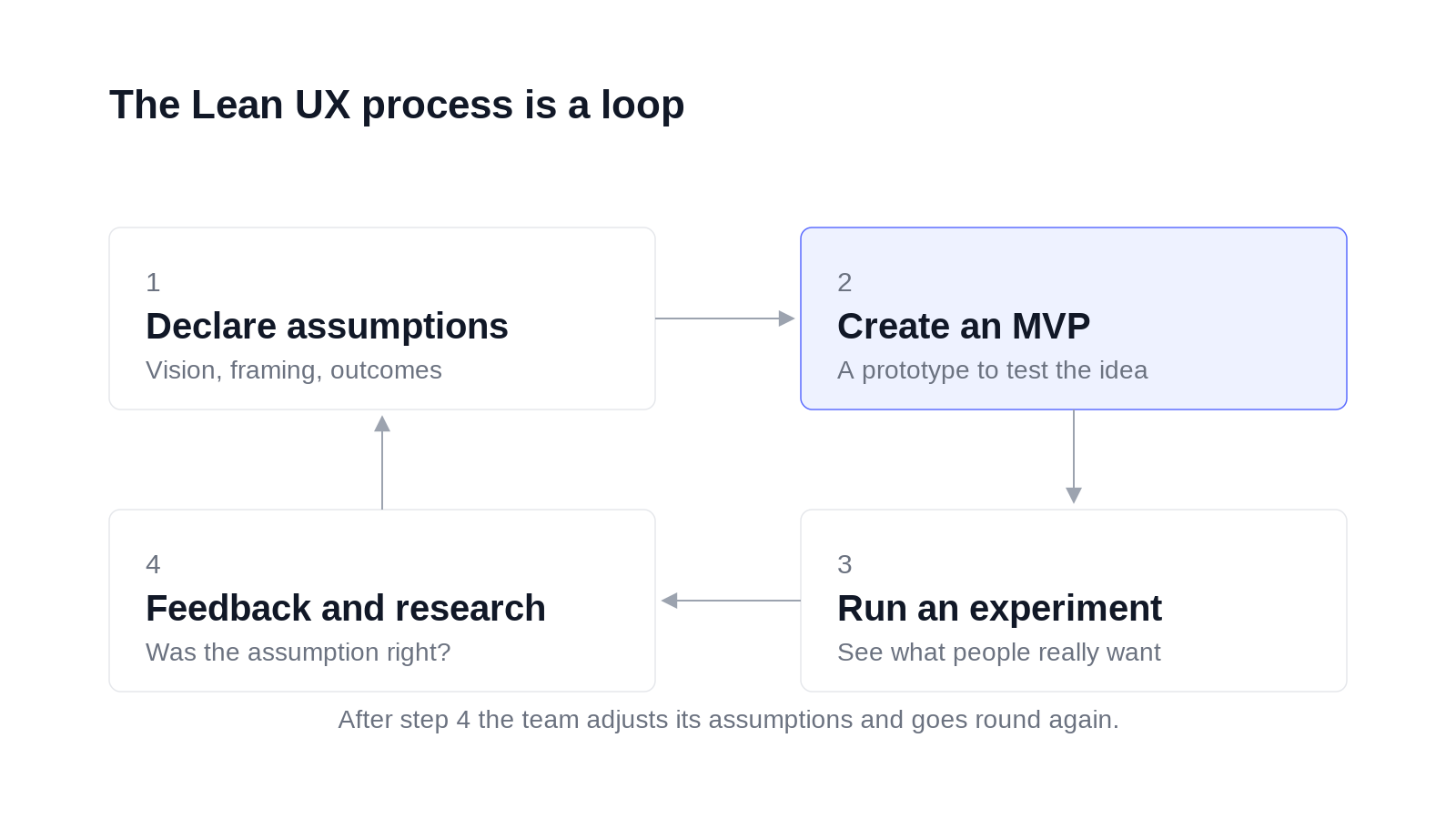
- Declare assumptions. The team writes down what it believes: the vision, the framing of the problem and the outcome it wants. This step produces the problem statement, the prioritised assumptions, the hypothesis, the outcomes, the personas and the features of the first product.
- Create an MVP. The MVP exists to test the assumption. It is typically a prototype, such as paper sketches or clickable wireframes. Lean UX suggests designing it collaboratively, so the team builds the product concept together and solves the design problem through a shared understanding.
- Run an experiment. The team puts the MVP in front of people to find out the market possibilities, and what people want, not just what they say.
- Feedback and research. The team collects feedback and analyses it. The result tells the team whether the assumption was right. In the next round, the team adjusts the assumption and runs another experiment. This is known as pivoting.
What is a minimum viable product (MVP)?
An MVP is the smallest version of a product that lets a team go through the Build-Measure-Learn feedback loop, made with the least possible effort (Ries, 2011). For Gothelf (2013), it is the smallest thing a team can do to learn whether its hypothesis is valid.
In Lean UX, an MVP is usually a prototype made of paper sketches or a clickable wireframe, built to collect the data that answers one hypothesis. It does not have to look like a product at all. An MVP can be:
- an e-mail
- an interview
- a button to nowhere
- a short video that explains what the product does and why someone should buy it (Ries, 2011)
How do you create an MVP?
There are several ways to create an MVP. Lean UX suggests a collaborative design process with five parts: identify the problem, generate ideas individually, present them, iterate, and then generate ideas as a team.
For the quality of that first version, Hokkanen, Kuusinen and Väänänen (2016) offer a framework called minimum viable user experience (MVUX). It supports early product development in startups.
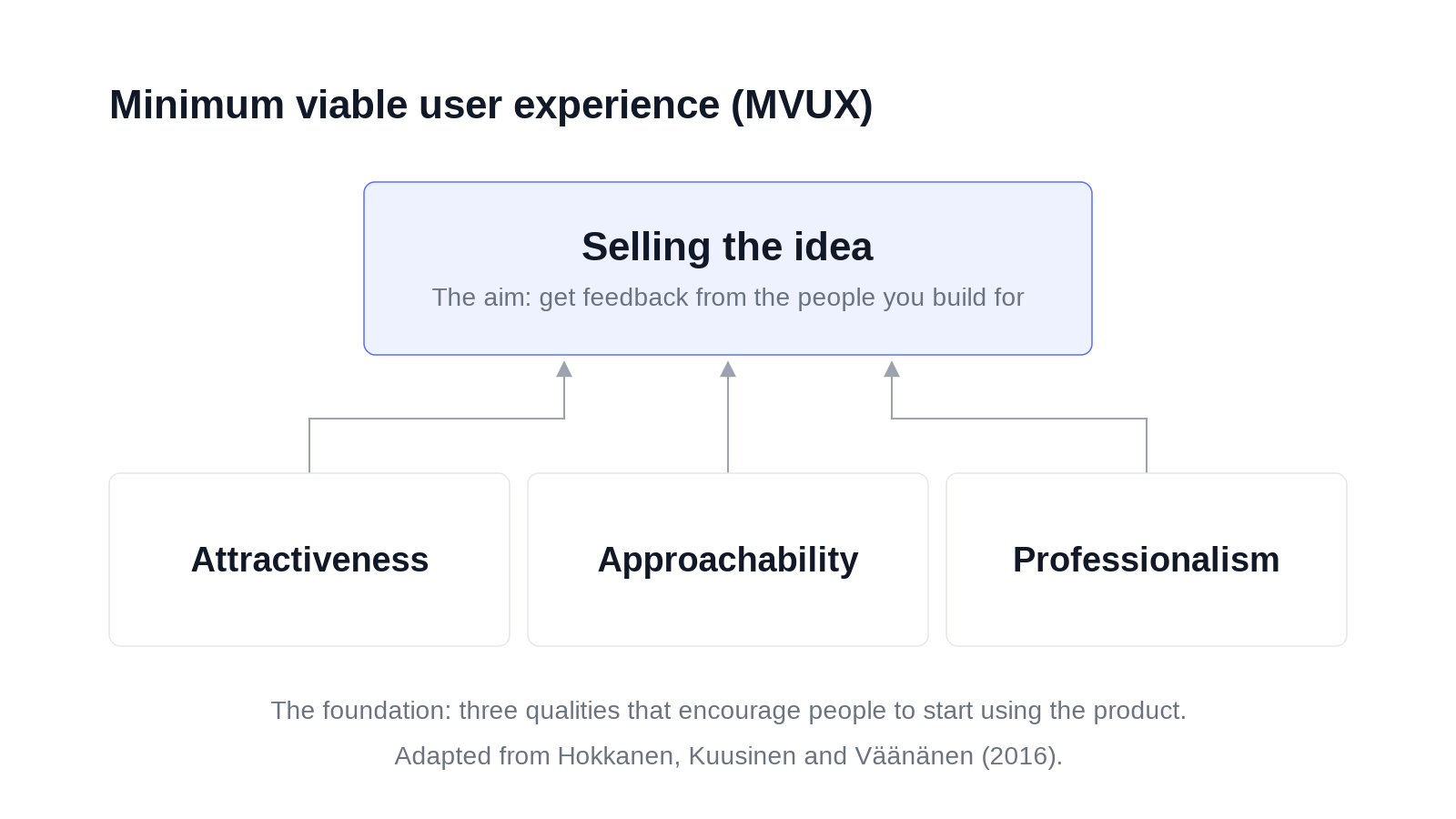
The framework has four elements. "Selling the idea" is the aim: it gives a startup the chance to get feedback from the people it is building for. The other three, attractiveness, approachability and professionalism, are the foundation that encourages people to start using the product.
Which kind of prototype should the MVP be?
Gothelf advocates building the MVP without code. He suggests four kinds of prototype, from the cheapest to the most realistic:
| Prototype | What it is |
|---|---|
| Low fidelity, on paper | Sketches on paper |
| Low fidelity, on screen | Clickable wireframes |
| Mid and high fidelity | Prototypes that look and behave closer to the real product |
| Hand-coded, with live data | A coded prototype that uses real data |
For low-fidelity prototypes, the 2013 book names tools such as Balsamiq, Microsoft Visio, OmniGraffle, Microsoft PowerPoint and Fluid Designer or POP (Prototyping on Paper). The tools have changed since then. The advice has not: choose the cheapest prototype that can answer your hypothesis.
What to do next
Write down one assumption about your product as a hypothesis. Then decide the smallest thing you could put in front of users this week to test it. If a paper sketch can answer the question, do not build more than a paper sketch.
Common questions
What are the four steps of the Lean UX process?
The four steps of the Lean UX process are: declare assumptions, create a minimum viable product (MVP), run an experiment, and collect feedback and research. The steps repeat in a loop, described by Jeff Gothelf in the 2013 book Lean UX.
What is an MVP in Lean UX?
In Lean UX, an MVP is the smallest thing a team can make to test a hypothesis and learn from it. It is usually a prototype such as paper sketches or a clickable wireframe, made with as little effort as possible.
Does an MVP need code?
No. Gothelf recommends building an MVP without code where possible. Paper prototypes, clickable wireframes and mid- or high-fidelity prototypes can all answer a hypothesis before any software is written.
What is pivoting in Lean UX?
Pivoting is what a team does after an experiment shows that an assumption was wrong or only partly right. The team changes the assumption and runs the next experiment to improve the product.
Sources
- Lean UX: Applying Lean Principles to Improve User ExperienceJeff Gothelf and Josh Seiden, O'Reilly Media, 2013
- The Lean StartupEric Ries, 2011
- Minimum Viable User Experience: A Framework for Supporting Product Design in StartupsHokkanen, Kuusinen and Väänänen, Springer (XP 2016), 2016
- Early phase of user involvement to validate the minimum viable product: an approach of Lean UXUniversity of Oulu, 2019
- What is Lean UX Design Process and how to create MVP for startup products? (first edition of this article)Atik Rahman, Bootcamp on Medium, 2021
Work with me
Building an AI product people have to trust? Tell me what you are working on.
Email me